

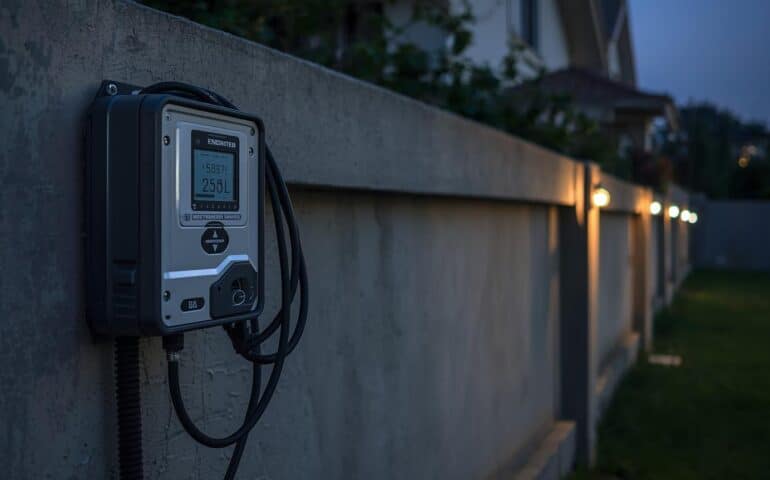
An electric fence is a perimeter security system that uses charged wires around the boundary of a property to deter anyone from climbing over or crossing the boundary. When someone touches the charged wires, they receive a short, sharp shock that discourages them from going further, while warning signs make it clear that the fence is electric. This guide explains, in plain terms, how the parts of an Electric Fence System work together.
The working principle of an electric fence is simple: a set of wires is fixed around the perimeter of a property, usually along the top of a boundary wall, and those wires are charged by an energizer. Together, the wires form a visible barrier and a deterrent. Anyone who tries to climb over the wall meets the charged wires first, and the shock they receive is intended to make them stop and move away.
The fence does not work as a single wire on its own. It works as a complete system, with the energizer, the wires, the insulators, the support rods and the grounding all playing a part. The installer plans the layout for the property, tests the complete system, and shows the owner how it works before handing it over. The layout is planned for each property, so ask about Electric Fence Installation in Lahore.
The energizer is the control unit at the heart of the system. It takes power from the mains supply and sends it to the fence wires in the form of pulses. Without the energizer, the wires would carry no charge and the fence would be only a physical barrier.
786 Surveillance Solution offers energizers from Tongher, Nemtek and Hikvision. The installer selects the energizer for the site, taking the property and its boundary into account, and a mobile phone control device is listed among the components of the systems supplied. The energizer is connected to the fence by HT insulated cable, so the charge is carried from the control unit to the fence lines. The energizer is one of the components of an electric fence system.
The energizer does not send a continuous current along the wires. Instead, it sends brief pulses at regular intervals, so the wires are charged in short bursts rather than all the time. Each pulse travels along the wires and back through the circuit, and the next pulse follows after a short pause.
This pulsing action is what makes the system work as a deterrent: a person who touches a wire feels the effect of a pulse, and the regular pulses keep the fence active while it is switched on. The pulses are brief and regular, and the site does not publish a pulse rate, so no figure is given here.
Grounding, or earthing, provides the return path that completes the electrical circuit. When a person touches a charged wire while standing on the ground, the circuit is completed through the ground and back to the energizer, and that is when the shock is felt. Without a proper return path through the ground, the circuit cannot work as intended.
For that reason, earthing must be done properly by the installer as part of the installation. It is not a detail to improvise or leave out, and the site does not publish earthing specifications, so no measurements or materials for the earthing are stated here.
The wires are the part of the fence that carries the charge around the perimeter. The systems supplied by 786 Surveillance Solution use stainless steel wires, held in place on support rods. The support rods fix the wires in position along the boundary wall, so the wires stay separated and in line around the property.
Insulators keep the charged wires separated from the support rods and the wall. If a charged wire touched the wall or a metal rod directly, the charge could leak away instead of staying in the wires, so the insulators are what keep the charge where it belongs. HT insulated cable is used to carry the charge from the energizer to the fence, and ferrules and tensioner springs are among the components that hold and tension the wires in place.
A high-power siren is included in the systems supplied, so the fence can alert people nearby as well as act as a physical deterrent, and warning signs are part of every system. The alarm and the visible warning signs work together with the charged wires: the signs warn people before they touch the fence, and the siren draws attention to the boundary.
The system also has a built-in UPS with battery. That means the fence keeps working during a power failure, because the battery backup supplies the energizer when the mains power is off. Regular checks of the battery backup and the wires are recommended as part of looking after the system, which otherwise does not require much maintenance.
Yes. The system has a built-in UPS with battery, so the fence keeps working during a power failure.
786 Surveillance Solution offers Tongher, Nemtek and Hikvision energizers. The best choice depends on the property and its boundary, and the installer selects the energizer for the site.
Electric fencing is provided in Lahore, Islamabad and Rawalpindi, for homes as well as commercial properties.
Every system comes with a 1 year warranty and lifetime service.
No. An electric fence system does not require much maintenance, and regular checks of the wires and the battery backup are recommended.
In short, an electric fence works as a complete system: the energizer sends brief, regular pulses along stainless steel wires held on support rods and separated by insulators, grounding completes the circuit, and a siren and battery backup keep the system alerting and working even when the power fails. For a complete setup, ask for a Professional Electric Fence System.